
Gift idea: what if you gave mental strength?

Finding a meaningful gift isn’t easy. We often end up giving one more thing to someone who already lacks nothing: a book they won’t read, another bottle for the cellar. It makes an impression when unwrapped, then joins the rest.
Some people have realised there is a better investment: investing in someone’s mindset. This kind of gift shines less on opening day. It reveals itself later, on the day it matters. High-level athletes have worked on it for years, yet most of us were never taught it: mental preparation. Still, it isn’t limited to sport.
What mental preparation changes, in concrete terms
I’ve already written about what mental preparation is in another article. Here, I’d rather focus on what it produces. Here are four outcomes I see regularly in sessions.
Less anxiety
A singer knew his repertoire inside out. The issue showed up backstage: a tight throat, shallow breathing, a voice constricting from the very first notes. We worked on breathing and on what happens in the body when pressure rises. Today, he walks on stage with his voice open. The nerves are still there. They no longer run the show.
Removing blocks
A tennis player was winning in practice and losing tight matches. Technically, nothing was missing. Yet at 5–5 in the final set, a quiet voice told him he didn’t belong there. Once that block was identified, he approached the end of matches differently, knowing he deserved to win. That doesn’t guarantee victory. It allows him to finally play at his true level.

Accessing your skill
A golfer had a solid swing, built over years. Under pressure, he adjusted it mid-motion—and that’s when the ball went offline. Mental preparation didn’t teach him technique. It taught him to trust what he already knew how to do. Many capable people are in this position. The ability is there; access to it closes at the moment it counts. And that applies everywhere: at work, in leisure, and even at school.
Greater ease with failure
A lawyer experienced every trial as a verdict on his own worth. He learned to focus on what he controls—case preparation, the quality of his argument—rather than the outcome, which also depends on a judge and opposing counsel. He pleads with greater freedom. And when he loses a case, he takes the lessons from it without coming undone.
You don’t need to be struggling to benefit
None of these people was in crisis. The singer was singing, the player was winning matches, the lawyer was arguing cases. They simply wanted to perform better on the day it mattered.
That is the biggest misconception about mental preparation. People assume it’s reserved for elite athletes or those in difficulty. Yet an athlete doesn’t see a mental performance coach because something is wrong. They do it because they want to be better—and they do it when things are going well, not after a defeat.
You don’t prepare for an exam after failing it.
Ninety minutes is enough for a serious assessment: what works, what drains energy, and the specific situation you want to approach differently. You leave with two or three tools practised in the session and a routine you can apply the very next day.
What can you give to someone who has everything?
That’s where the idea becomes a gift. For someone who lacks nothing, a mental preparation session is an original gift, and above all, a meaningful one. You aren’t giving an object. You’re giving dedicated space and tools that last.
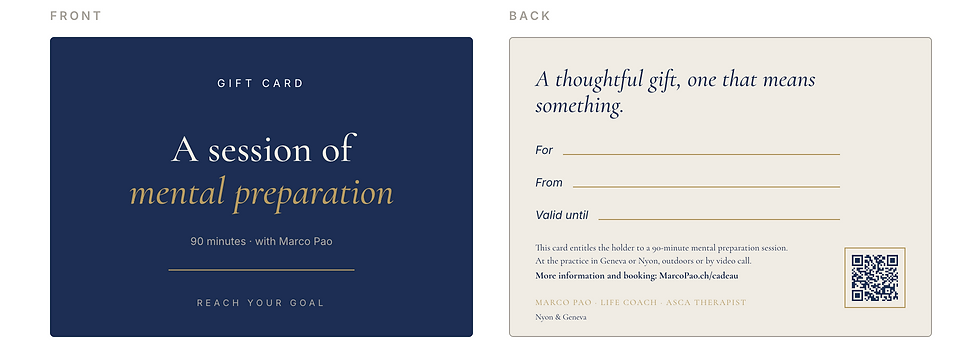
In concrete terms:
a 90-minute session, via video conference in Geneva or Nyon or outdoors;
a printed card, sent by mail to the address of your choice;
three months validity, the person can book whenever they wish;
200 CHF, card and postage included.
The session remains confidential: the person giving the gift receives no information about its content.
A brief word of care. This gift suits someone who wants to move forward. It isn’t meant to send the message "you should get help." If you’re unsure, feel free to write to me before ordering.


Comments